
HiLetgo 3pcs ESP8266
4.2Editor score
Three Unit Pack
Low Cost Option
Basic AP STA Modes
This guide compares the top ten Arduino WiFi Module options for reliable wireless connectivity and smart device integration.
Selecting the right Arduino WiFi Module is crucial for modern IoT projects. These boards enable seamless wireless communication, allowing your microcontroller to connect to networks and exchange data efficiently.
We compared ten top-rated models based on connectivity, processing power, and ease of use. This list covers everything from compact transceivers to full-featured development boards with Bluetooth.
Each pick highlights specific strengths for different project needs. Remember that availability and prices may fluctuate over time, so check current listings before purchasing your components.
4.2Editor score

4.7Editor score

4.7Editor score
The following table provides a quick side-by-side overview of all ten products to help you decide quickly based on key specifications and features.



The Arduino UNO R4 WiFi stands out as a powerful evolution of the classic board, offering dual-core processing and modern connectivity options for advanced projects.
We may earn a commission when you buy through this link, at no additional cost to you.
Its combination of the Renesas RA4M1 and ESP32-S3 chips provides robust performance for real-time data processing and edge AI applications.
While the price is higher than basic modules, the integrated features like the 12-bit DAC and CAN support justify the cost for professional use.
Developers seeking a comprehensive solution for complex IoT tasks will find this board an excellent investment for their prototyping needs.
The dual-core setup allows you to run Wi-Fi tasks on one core while managing project logic on the other for better efficiency.
With USB-C and Qwiic connectors, you can streamline your wiring and power delivery significantly compared to older boards.
We may earn a commission when you buy through this link, at no additional cost to you.
This three-pack offers incredible value for beginners who need multiple wireless modules for different projects or testing scenarios.
We may earn a commission when you buy through this link, at no additional cost to you.
The ESP8266 chip supports essential Wi-Fi modes and integrates well with standard Arduino development environments.
Although it lacks advanced features like USB-C, it delivers reliable connectivity for simple sensor networks and smart home devices.
It is an ideal choice if you need to equip several prototypes without spending much money on components.
Buying a pack of three ensures you have backups ready and reduces the cost per unit significantly.
The AP and STA modes allow you to create access points or connect to existing routers with ease.
We may earn a commission when you buy through this link, at no additional cost to you.
The ESP-01S version improves on the original with better signal strength and more onboard flash memory for firmware.
We may earn a commission when you buy through this link, at no additional cost to you.
This module is designed for serial communication and requires an external USB-to-serial adapter for programming and debugging.
It remains a solid standard choice for compact projects where space is limited but reliable Wi-Fi is essential.
Use this module when you need a lightweight, cost-effective component that fits into tight physical spaces easily.
Upgraded antenna design helps maintain a stable connection even in environments with some wireless interference.
The 4MB flash allows you to store more complex firmware without needing external storage solutions.
We may earn a commission when you buy through this link, at no additional cost to you.
This five-pack provides ample quantities for bulk projects or for stocking your workspace with reliable wireless components.
We may earn a commission when you buy through this link, at no additional cost to you.
It uses the classic ESP-01 form factor which is widely supported by various development boards and libraries.
Be careful with power supply voltage since these modules only accept 3.3 volts directly to prevent hardware damage.
If you are building multiple sensors for a large network, this pack offers the most practical and economical option.
Having five units allows you to distribute them across different locations for a larger sensor network.
Ensure you use a regulator or adapter if your power source exceeds 3.6 volts to keep the device safe.
We may earn a commission when you buy through this link, at no additional cost to you.
These boards bring the powerful ESP32 processor to your desk with modern USB-C connectivity and Bluetooth capabilities.
We may earn a commission when you buy through this link, at no additional cost to you.
The dual-core design enables you to handle complex logic tasks while maintaining a steady wireless connection simultaneously.
Over-the-air update support means you can fix bugs remotely without needing physical access to every single board.
This set is perfect for intermediate developers who need more power than the 8266 but want a complete development board.
You can dedicate one core to network management and the other to your main application logic easily.
The OTA feature simplifies the maintenance of deployed devices by allowing remote firmware upgrades via Wi-Fi.
We may earn a commission when you buy through this link, at no additional cost to you.
This Nano variant offers a compact form factor with the latest ESP32-S3 chip for superior processing and connectivity.
We may earn a commission when you buy through this link, at no additional cost to you.
It supports MicroPython which makes it accessible for those who prefer Python over C++ for embedded development tasks.
HID support allows you to turn your device into a keyboard or mouse, opening up new interaction possibilities for users.
Ideal for wearable tech or modern IoT prototypes, it bridges the gap between simple sensors and smart interactive devices.
Using MicroPython simplifies the coding process for rapid prototyping and allows for easier debugging sessions.
Creating custom HID devices allows you to build unique input peripherals for computers and tablets easily.
We may earn a commission when you buy through this link, at no additional cost to you.
A pack of four units offers a balanced option for those needing multiple modules without buying in bulk.
We may earn a commission when you buy through this link, at no additional cost to you.
The RF components are self-calibrated to ensure optimal performance and stability across different environmental conditions.
These modules are made from durable materials allowing for reuse across different projects if handled with care.
They fit well into home automation scenarios and wearable electronics where size and reliable data transfer are key.
Self-calibration ensures that the radio frequency output remains consistent and reliable during operation.
Robust construction means you can unplug and repurpose these modules for future ideas without damage.
We may earn a commission when you buy through this link, at no additional cost to you.
This five-pack provides excellent value with the upgraded 4MB flash memory for storing more complex applications.
We may earn a commission when you buy through this link, at no additional cost to you.
Ensure you select the DOUT SPI mode in your IDE to program these modules correctly to avoid errors.
The high flash capacity is particularly useful for projects that require logging data or storing large configuration files.
It is a reliable choice for building IoT nodes that need to operate independently with more local storage capability.
With 4MB of flash you can store more code and data locally than on standard 1MB modules.
Selecting the correct SPI mode during setup is critical for successful firmware uploads and operation.
We may earn a commission when you buy through this link, at no additional cost to you.
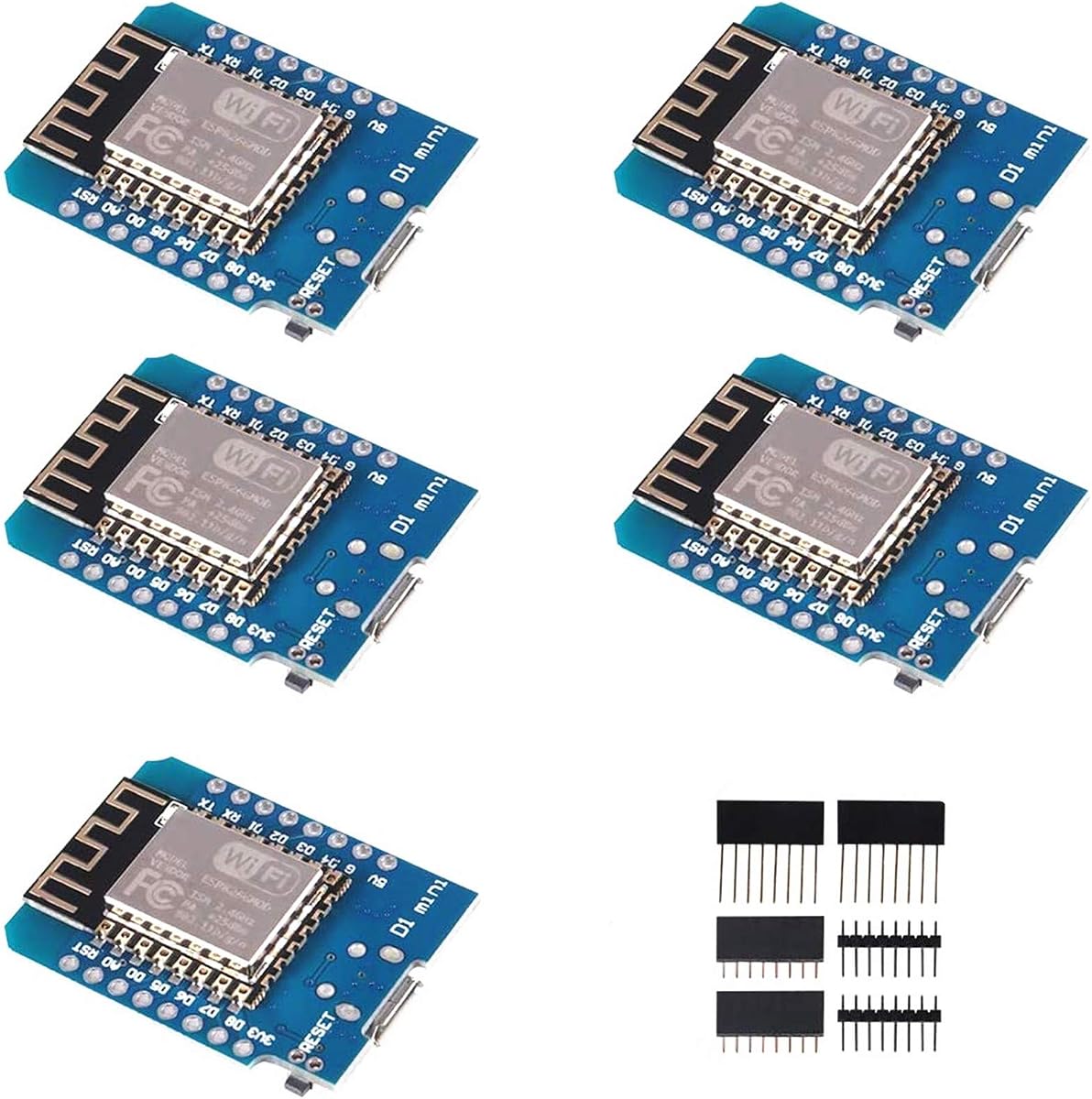
The D1 mini form factor offers a tiny package with significantly more GPIO pins than the basic 01 modules.
We may earn a commission when you buy through this link, at no additional cost to you.
It includes a built-in USB connection and power supply which simplifies wiring compared to raw serial transceivers.
You get 11 digital pins and analog support making it versatile for connecting multiple sensors directly to the board.
This module is ideal for compact projects where you need more physical connections without adding extra breakout boards.
Access to more pins allows you to control LEDs, sensors, and motors directly without multiplexers.
The onboard regulator means you can plug it directly into a USB port for power and programming.
We may earn a commission when you buy through this link, at no additional cost to you.
For those deploying large-scale projects, this ten-pack offers the highest quantity at a competitive price point.
We may earn a commission when you buy through this link, at no additional cost to you.
It is ideal for businesses or labs that need to standardize on a single module type across many different devices.
The robust processing capabilities ensure that each unit can handle its own network tasks efficiently and reliably.
Choose this pack if you are equipping an entire facility with smart sensors or building a massive network prototype.
Standardizing on one part number simplifies procurement and inventory management for larger production runs.
The price per module decreases significantly when buying in bulk compared to smaller individual packs.
We may earn a commission when you buy through this link, at no additional cost to you.
Selecting the right module requires balancing power, connectivity, and ease of use based on your specific project needs.
The processor chip determines how fast your device can run logic and process data. For simple sensors a basic ESP8266 is sufficient but complex applications benefit from dual-core ESP32 chips that handle more tasks efficiently.
Prioritize boards with sufficient processing speed if your project involves real-time data analysis or edge computing tasks.
WiFi modules generally connect to 2.4 GHz networks but Bluetooth is also a valuable addition for proximity control. Look for Bluetooth 5.0 if you need better range and lower energy consumption for smart home interactions.
Ensure the module supports the modes you need such as AP for direct connection or STA for router integration.
Many WiFi modules operate at 3.3V and can be damaged if connected directly to a 5V source. Always check the voltage tolerance and use appropriate regulators or adapter boards to supply clean stable power.
For battery projects choose boards with low power sleep modes to maximize operational life between charges.
Flash memory is crucial for storing your firmware and any local data logs. Basic modules might have 1MB but newer versions offer 4MB which allows for more complex code and data retention capabilities.
Choose higher capacity flash if you plan to store configuration files or logs on the device itself.
The size of the module affects how it fits into your enclosure or PCB. Small serial transceivers save space but might require external USB adapters whereas development boards offer built-in USB ports.
Consider your project enclosure constraints when deciding between raw modules and ready-to-use development boards.
Some boards support MicroPython or have built-in USB-to-serial converters which make uploading code much simpler. Boards with physical headers and clear pin labels also reduce the time spent wiring and debugging.
Look for boards with USB-C connectivity to ensure you have a modern and reliable connection method for uploads.
Support for multiple WiFi modes such as AP STA and AP STA gives you flexibility in how devices connect. AP mode lets the board create its own network while STA mode connects it to your home router.
Select a module that supports the specific network topology your application requires for seamless operation.
Buying in packs reduces the cost per unit and ensures you have backups if a module gets damaged. For testing or classroom use multi-packs are practical and economical compared to buying single units.
Decide how many units you need upfront to take advantage of bulk pricing options when available.
Always start by connecting the module to a stable 3.3V power source and verifying the pins before uploading any code.
Install the necessary drivers for your USB interface and select the correct board type in your IDE to ensure compatibility.
Keep the module in a dry environment and avoid touching exposed pins to prevent static damage during handling.
AP mode allows the module to create its own WiFi network for devices to connect to. STA mode connects the module to an existing router network. You can use both simultaneously for more complex setups.
Yes most of these modules are compatible with the Arduino IDE. You may need to add board manager URLs or select specific generic board options to enable programming.
Common causes include insufficient power supply voltage or interference from other electronic devices. Ensure you are using a stable regulator and placing the antenna away from metal casings.
ESP32 boards are generally better for battery projects because they support deep sleep modes. This allows the device to wake up and transmit data periodically while saving energy.
Yes raw serial modules do not have a USB port. You will need a USB to serial adapter to connect them to your computer for programming and debugging purposes.
Not all boards support MicroPython out of the box. Look for boards explicitly mentioning MicroPython compatibility if you prefer Python over C++ for development.
The Arduino UNO R4 WiFi stands out for its dual-core power and modern features while the ESP8266 packs offer great value for simpler tasks.
Prioritize voltage requirements and power modes to ensure your device runs reliably especially if it is battery operated or outdoors.
Always check current availability and pricing before purchasing to make sure you get the best deal for your project budget.