
Yxk Zero1 2-Bay Desktop NAS
4.4Editor score
2.5GbE high speed connectivity
Compact and quiet design
Remote access from any device
Discover the top diskless NAS enclosures for home and office. This guide compares ten leading models for performance, features, and reliability to help you
Finding the right storage solution is essential for modern digital lives. A diskless NAS enclosure offers a flexible way to build your own private cloud without pre-installed drives. This allows you to choose drives that match your specific budget and capacity needs perfectly.
We have carefully evaluated ten top models from reputable brands like Synology, UGREEN, and QNAP. Our analysis focuses on build quality, network speed, software ecosystem, and overall value. This list covers everything from simple entry-level units to powerful workstation-grade systems.
Each pick highlights key strengths, ideal use cases, and important specifications. You will see how each unit handles backups, media streaming, and security. Please note that product availability and pricing can change frequently, so verify details before purchasing.
4.4Editor score

4.6Editor score

4.6Editor score
The following table provides a side-by-side comparison of all ten selected diskless NAS enclosures. It highlights key specifications to help you quickly identify which model fits your storage requirements.




The Synology 2-Bay DiskStation DS223j stands out as a top choice for home users seeking reliability and ease of use. With a high user rating, this diskless NAS enclosure ensures secure private cloud access and automated backups for various devices.
We may earn a commission when you buy through this link, at no additional cost to you.
Its software ecosystem is a major strength, offering tools for file sharing, media streaming, and even home security system integration. Users benefit from Synology's expert customer support and ongoing software updates that enhance functionality over time.
While the hardware is solid, the limitation to two drive bays means it may not suit those needing massive storage expansion. However, for most personal users, the balance of cost, performance, and features remains highly acceptable.
This model is ideal for individuals or small families wanting a straightforward private cloud solution. We recommend it for anyone prioritizing data ownership and seamless cross-platform access without technical complexity.
Secure private cloud access ensures 100% data ownership and multi-platform access from anywhere safely.
Integrated home security and automated backup protection keep your data and property monitored 24/7.
We may earn a commission when you buy through this link, at no additional cost to you.
The TERRAMASTER D8 Hybrid 2 enclosure offers unique flexibility by supporting four HDDs and four NVMe SSDs simultaneously. Its perfect rating highlights exceptional performance with speeds up to 1020 MB/s for fast file transfers.
We may earn a commission when you buy through this link, at no additional cost to you.
Innovative power management technology optimizes energy efficiency and operational safety. The device supports flexible storage expansion and simpler file management, making it suitable for creative professionals requiring high throughput.
Although it lacks built-in RAID, users can leverage third-party software if needed. The main trade-off is reliance on the host computer for processing, which might limit standalone utility compared to full NAS systems.
This enclosure is perfect for editors or users needing rapid access to large media files. It bridges the gap between massive HDD capacity and SSD speed effectively.
Combines 4 HDDs and 4 NVMe SSDs to support up to 152TB of total storage capacity.
USB 3.2 Gen2 protocol enables read speeds up to 1020 MB/s for efficient workflows.
We may earn a commission when you buy through this link, at no additional cost to you.
The Yxk Zero1 2-Bay NAS provides an affordable entry point into private cloud storage. With a strong user rating, it delivers stress-free personal storage without recurring subscription fees or complex setup requirements.
We may earn a commission when you buy through this link, at no additional cost to you.
Its 2.5GbE connectivity ensures faster file transfers compared to standard 1GbE links. Docker support allows tech-savvy users to expand functionality, while real-time health monitoring keeps data safe from failures.
Trade-offs include entry-level hardware that might struggle with heavy multitasking. However, for personal photo backup and media streaming, the performance remains more than adequate for most households.
We recommend this for beginners seeking a one-time investment for lifelong storage freedom. It is an excellent choice for those who value privacy and control over their data.
One-time purchase allows complete control of data without monthly bills or storage limits.
2.5GbE ports provide 2.5x faster speeds than standard 1GbE for quick file transfers.
We may earn a commission when you buy through this link, at no additional cost to you.
The UGREEN NAS DXP4800 GT is designed for creators and teams needing high performance. With a powerful AMD Ryzen processor and dual 10GbE networking, it handles backups and media processing smoothly.
We may earn a commission when you buy through this link, at no additional cost to you.
UGOS Pro offers a clean interface and supports Docker, virtual machines, and extensive app ecosystems. Users can expand into Plex, Home Assistant, and more, all managed through a central app.
While powerful, the price and feature set might be overkill for simple home users. However, the local privacy and pro-grade security features justify the investment for power users.
This model is ideal for offices or tech enthusiasts building a robust private cloud. It offers scalability and speed that few competitors match in this category.
Powered by AMD Ryzen R2514 with 8GB RAM expandable to 64GB for smooth workflows.
Dual ports provide up to 20Gbps aggregate bandwidth for faster large file transfers.
We may earn a commission when you buy through this link, at no additional cost to you.
The QNAP TR-004 serves as a versatile USB Type-C DAS for Windows, macOS, and Linux. With a solid user rating, it allows you to expand the capacity of your existing QNAP NAS efficiently.
We may earn a commission when you buy through this link, at no additional cost to you.
It supports hardware RAID configurations like RAID 0, 1, 5, and JBOD for data protection. Lockable drive bays ensure physical security, while the USB-C interface enables high-speed data transfers.
Because it requires a host connection, it is not a standalone network device. This trade-off limits its utility for remote access but makes it ideal for local backup solutions.
We recommend this for users needing extra storage for their main NAS system. It is a reliable option for expanding capacity without replacing existing drives.
Supports RAID 0, 1, 5, and JBOD to secure data against drive failures.
Direct attached storage via USB-C allows fast connection to computers and NAS.
We may earn a commission when you buy through this link, at no additional cost to you.
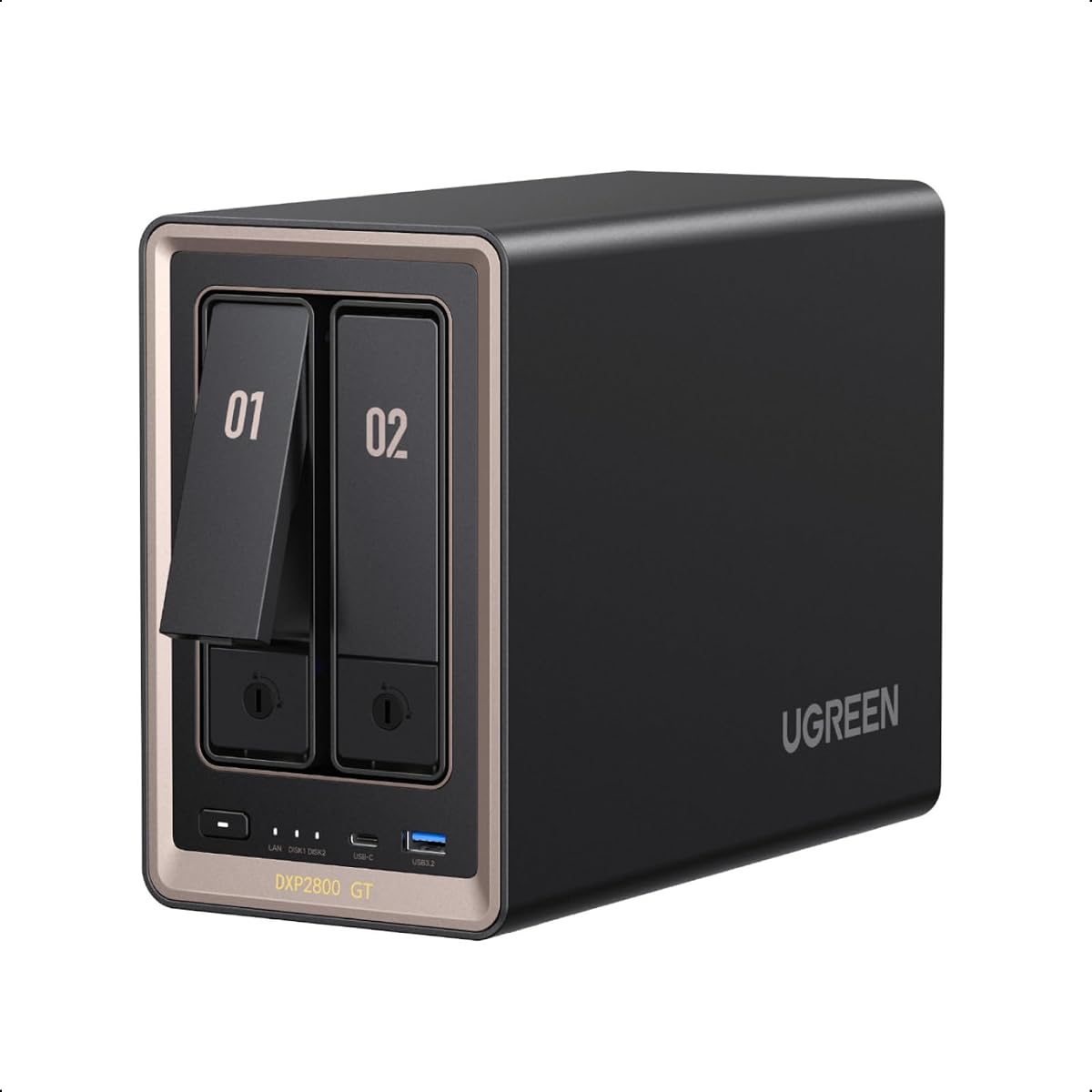
The UGREEN DXP2800 GT combines speed and privacy for freelancers and smart home users. With 10GbE networking and an AMD processor, it accelerates backups and media streaming efficiently.
We may earn a commission when you buy through this link, at no additional cost to you.
It includes a built-in surveillance center for local recording, helping avoid cloud subscription fees. Local privacy features like TLS and RAID protection keep your data secure and private.
The two-bay limit might restrict expansion plans later. However, the high throughput and privacy tools make it a compelling choice for independent professionals.
This unit is perfect for freelancers needing rapid access to large files locally. It supports growing digital life without compromising on speed or control.
10GbE networking accelerates backups and file sharing for heavy workflows.
Advanced encryption and RAID help safeguard data without relying on third-party clouds.
We may earn a commission when you buy through this link, at no additional cost to you.
The Synology 4-Bay DiskStation DS925+ offers balanced performance for small businesses. With dual 2.5GbE ports and solid transfer speeds, it supports efficient data transfers and redundancy.
We may earn a commission when you buy through this link, at no additional cost to you.
It leverages built-in file and photo management, virtualization, and surveillance solutions. A 3-year limited hardware warranty ensures reliability for critical business operations.
While it lacks 10GbE ports, the 2.5GbE speed is sufficient for many office needs. The main trade-off is the higher price point compared to entry-level models.
We recommend this for small businesses needing reliable file storage and collaboration tools. It supports professional workloads without unnecessary complexity.
Dual ports provide fast network transfer speeds and increased redundancy for office use.
Supports virtualization and surveillance solutions for centralized business management.
We may earn a commission when you buy through this link, at no additional cost to you.
The Synology DS425+ is designed for team productivity and media hubs. With speeds up to 278 MB/s, it supports concurrent access from 10+ users effectively.
We may earn a commission when you buy through this link, at no additional cost to you.
It provides a centralized repository with granular access controls and audit logs for security. A 3-year warranty and enterprise support ensure stable performance for business-critical production.
The cost is higher than home units, but the collaboration features justify it. The trade-off involves higher entry cost, but the value for teams is significant.
We recommend this for offices requiring secure file sharing and media streaming. It excels in centralized management and data protection.
Share large files and stream media across your office with high speed and reliability.
Store company documents with granular access controls and audit logs for security.
We may earn a commission when you buy through this link, at no additional cost to you.
The Synology 5-Bay Expansion Unit DX515 adds massive capacity to existing Synology DiskStations. With a high user rating, it supports adding 5 additional drives seamlessly.
We may earn a commission when you buy through this link, at no additional cost to you.
It uses DSM unified tools to configure new storage in minutes. Plug-and-play compatibility and hot-swapping support make maintenance easy for users.
You must own a compatible Synology NAS to use this unit. This limits standalone utility but makes it the best option for scaling existing setups.
We recommend this for Synology users needing more space without replacing their main unit. It provides flexible, cost-effective expansion.
Add 5 additional drives to your DiskStation instantly for seamless storage growth.
Configure new storage quickly with Synology DSM's intuitive management interface.
We may earn a commission when you buy through this link, at no additional cost to you.
The TrueNAS Mini X+ is a compact enterprise-grade storage server with ZFS capabilities. With a strong user rating, it ensures data integrity and protection against corruption.
We may earn a commission when you buy through this link, at no additional cost to you.
It comes with 32GB ECC RAM and an eight-core CPU for high performance. TrueNAS Community Edition supports various clients and file-sharing protocols like NFS, SMB, and S3.
The price is significantly higher, and the setup is complex. However, the self-healing ZFS filesystem makes it a top choice for critical data storage.
We recommend this for businesses needing robust data protection and virtualization. It is a powerful solution for developers and SMBs.
Protected by the self-healing ZFS filesystem to keep data safe and free from corruption.
Features 32GB ECC RAM and an eight-core CPU for handling demanding workloads.
We may earn a commission when you buy through this link, at no additional cost to you.
Choosing the right diskless NAS enclosure involves evaluating hardware, software, and networking capabilities to fit your needs.
The number of drive bays determines your maximum storage potential. Consider future expansion needs before purchasing a 2-bay or 4-bay unit.
Ensure the chassis supports the largest drive size you plan to install for flexibility.
Gigabit Ethernet is standard, but 2.5GbE or 10GbE ports offer faster transfer speeds for large files. Choose based on your home network setup.
High-speed networking is critical for video editing or multi-user environments.
A faster processor and more RAM improve multitasking and virtualization capabilities. Entry-level units work for basic storage, while enthusiasts need higher specs.
Check for expandability to upgrade memory as your needs grow.
The operating system affects ease of use and available apps. Look for intuitive interfaces with robust backup, sharing, and media tools.
Strong software support ensures long-term usability and security updates.
RAID configurations protect data against drive failures. Ensure the device supports your preferred RAID level for redundancy.
Hardware RAID is generally faster and more reliable than software-only solutions.
Efficient power management saves money and reduces heat. Look for units with sleep modes or energy-saving features.
Lower power draw is vital if the NAS runs 24/7 for backups.
A longer warranty period indicates manufacturer confidence. Check for accessible customer support channels and community forums.
Strong support ensures help is available if hardware issues arise.
Begin by installing compatible hard drives or SSDs into the drive bays. Ensure they are seated securely to prevent connection issues.
Connect the unit to your router and power it on. Follow the manufacturer setup wizard to install the OS and configure user accounts.
Regularly update the firmware to patch security vulnerabilities. Monitor drive health and replace aging disks before failure to avoid data loss.
Yes, diskless NAS enclosures come without drives. You must purchase compatible SATA or NVMe drives separately to store data. This allows you to choose the capacity and brand that fit your budget.
A NAS connects to your network via Ethernet for shared access, while a DAS connects directly to a computer via USB. NAS offers broader accessibility and advanced software features compared to DAS.
Many modern NAS units allow RAM upgrades to improve performance. Check the specific model compatibility list before purchasing additional memory modules to ensure they work.
RAID adds redundancy to protect against data loss if a drive fails. While not strictly necessary, it is highly recommended for important documents or large media libraries.
Most enclosures offer remote access via mobile apps or web portals. Configure secure remote access settings during setup to allow safe access from outside your home network.
Regular maintenance includes updating firmware, monitoring drive health, and cleaning dust from vents. These steps ensure optimal performance and longevity of the hardware.
Our top picks include the Synology 2-Bay DiskStation for ease of use, the TERRAMASTER D8 for mixed storage, and the UGREEN DXP4800 for high performance. Each offers unique benefits depending on your goals.
Prioritize software ease and network speed when making a choice. Reliability and data protection should guide your investment to ensure peace of mind.
Please check current prices and availability before purchasing as market conditions change frequently. We hope this guide helps you find the perfect storage solution for your needs.