
SHILLEHTEK Universal Power Supply Module
4.6Editor score
Universal Compatibility
Dual Voltage Output
Flexible Power Options
This expert guide compares the top 12V breadboard power supply options for makers, featuring detailed reviews and a buying guide to help you choose.
Finding a reliable power source is critical for any electronics hobbyist or engineer working on prototyping projects. A stable 12V breadboard power supply ensures your microcontrollers and sensors receive consistent voltage without fluctuations that could damage components or skew test results. Whether you are building a simple LED circuit or a complex IoT device, having the right power distribution board simplifies your workflow significantly.
We have evaluated a wide range of modules based on voltage stability, current capacity, safety features, and ease of use. Our analysis focuses on how well each unit integrates with standard breadboards, the flexibility of input options, and the inclusion of protective circuits like short-circuit prevention. This list covers versatile solutions suitable for beginners, students, and professional developers alike who need dependable power for their workbenches.
Each pick in this guide highlights specific strengths such as dual-channel control, USB compatibility, or adjustable output settings. You will find detailed breakdowns of features and real-world performance expectations for every product listed. Please note that product availability and pricing can change over time, so we recommend verifying current details before making a final purchase decision for your specific project needs.
4.6Editor score

4.5Editor score

4.5Editor score
The following table provides a side-by-side comparison of all ten reviewed products, highlighting key specifications and unique selling points to help you quickly identify the best match for your prototyping needs.




This dual-pack module stands out as a highly versatile solution for modern electronics prototyping. With a strong rating, it is designed to replace older cable-dependent power supplies by supporting both Type-C USB and traditional DC jack inputs. The independent channel control allows you to run different voltages on each rail simultaneously, which is essential for mixed-voltage circuits involving microcontrollers and sensors.
We may earn a commission when you buy through this link, at no additional cost to you.
The standout feature is the flexibility in power distribution. You can toggle between 3.3V and 5V independently for both left and right rails, ensuring your Arduino and ESP32 components receive exactly the power they need. The onboard LED indicators provide immediate visual feedback on power status, reducing guesswork during setup. Additionally, the short-circuit protection adds a critical layer of safety for expensive electronic parts.
While the unit is robust, it has limitations regarding maximum current output. The 5V channel supports up to 2A, but the 3.3V channel is limited to 1A, which might not be sufficient for power-hungry peripherals like high-performance motors. However, for standard prototyping tasks involving logic boards and sensors, these limits are generally acceptable and well within safe operating ranges.
This module is ideal for hobbyists and educational settings where having a backup unit or multiple stations is beneficial. The inclusion of two boards allows you to organize projects by complexity or voltage requirements without needing to swap modules constantly. For anyone looking to upgrade their breadboarding setup with a reliable and modern power solution, this package is an excellent choice.
Supporting both Type-C USB and DC jack inputs means you can use modern chargers or wall adapters without hunting for old cables.
Separate switches for left and right rails allow you to power different parts of your circuit with distinct voltages or turn one side off completely.
We may earn a commission when you buy through this link, at no additional cost to you.
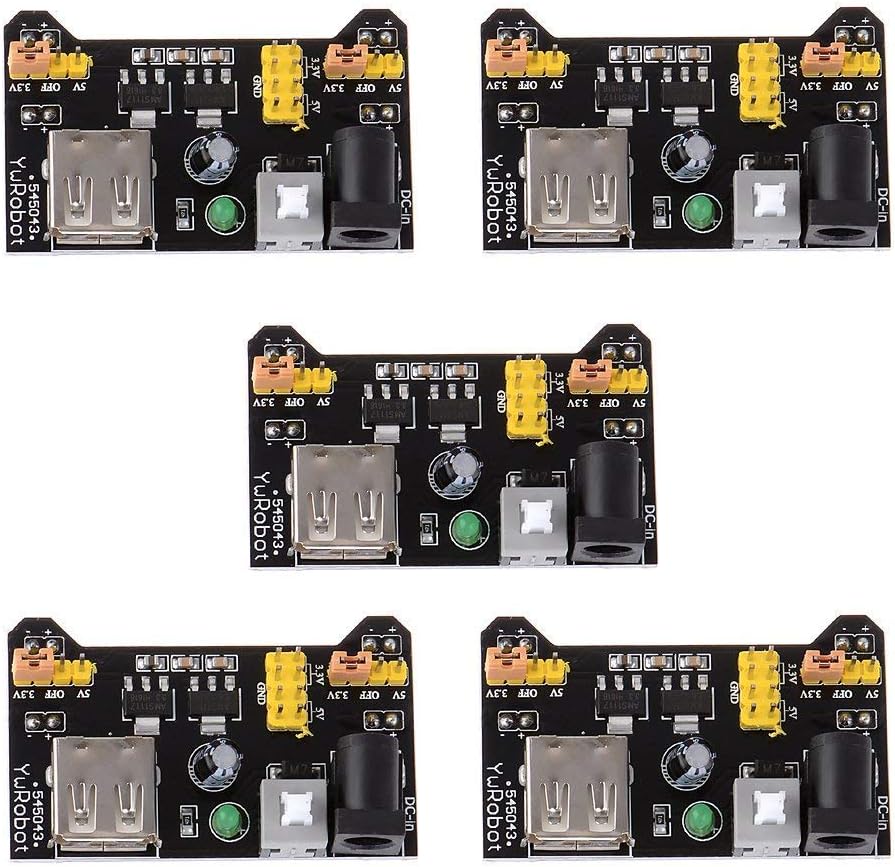
For users needing multiple units for a classroom or large project, this five-piece pack offers significant value. Each module is designed to fit standard 400 and 830-point solderless breadboards, making them widely applicable for general electronics work. The inclusion of 9V connectors simplifies the process of powering the units using common battery packs or adapters.
We may earn a commission when you buy through this link, at no additional cost to you.
The core functionality centers on providing stable 3.3V and 5V outputs from either USB or DC inputs. This flexibility allows for portable projects using batteries or stationary setups using wall adapters. The modules are straightforward to operate, with clear selection mechanisms for voltage output. While they lack some advanced features found in higher-end models, they perform reliably for basic prototyping tasks.
However, the current output is limited to less than 700mA, which restricts their use for projects requiring higher power. Additionally, the protection features are minimal compared to modules with built-in short-circuit safeguards. Users should be cautious when wiring to avoid accidental shorts that could damage the module or connected components.
This option is best suited for educational environments or hobbyists who need spare power supplies for group activities. The bulk quantity ensures that everyone has access to power without waiting for replacements. If your projects are low-power and budget is a primary concern, these modules offer a practical and cost-effective solution.
Getting five modules in one package allows you to equip multiple workstations or keep spares ready for future projects without extra cost.
The included 9V connectors make it easy to power these modules using standard batteries for portable or temporary setups.
We may earn a commission when you buy through this link, at no additional cost to you.
This kit is an excellent starting point for anyone new to electronics, providing all the essential components in one box. It includes a breadboard, power module, and jumper wires, eliminating the need to source items separately. The inclusion of a 12V 1A adapter ensures you have a ready-to-use power source that matches the module requirements perfectly.
We may earn a commission when you buy through this link, at no additional cost to you.
The power module is designed for compatibility with Arduino and Raspberry Pi projects, offering standard 3.3V and 5V outputs. The independent control allows for flexible testing of different circuit configurations. This setup is particularly helpful for students or beginners who want to avoid compatibility issues when starting their first projects.
One consideration is the size of the included breadboard, which is a standard 830-point size but may have tighter spacing than premium boards. The adapter provided is sufficient for most low-power tasks, but users with higher current needs may need to upgrade it later. These factors are minor trade-offs given the convenience of the complete package.
For those looking to dive into electronics without hunting for individual parts, this kit removes the guesswork. It is especially useful in educational settings where consistency across student kits is required. If you value convenience and a complete package over individual component selection, this kit is a strong contender.
Having the breadboard, wires, and power adapter together saves time and ensures all components work well with each other from the start.
The included instructions and components make it easy for first-time users to power their circuits without confusion or extra purchases.
We may earn a commission when you buy through this link, at no additional cost to you.
HiLetgo is a well-known brand in the maker community, and this five-pack continues to deliver reliable performance for breadboard power needs. The MB102 design is industry-standard, ensuring easy replacement or expansion as your collection grows. Each unit provides selectable 3.3V and 5V outputs, meeting the needs of most common microcontroller projects.
We may earn a commission when you buy through this link, at no additional cost to you.
The simplicity of these modules is their greatest strength. They plug directly into standard breadboards and require no additional wiring to function. The input options support both USB for portability and DC for stability, offering flexibility depending on your workspace. However, the lack of LED indicators means you must rely on multimeters or visual checks to confirm power is on.
The current limitation of under 700mA is a critical detail to consider. While adequate for logic boards and small sensors, it is not suitable for driving motors or high-brightness LED arrays. Users need to ensure their circuit requirements stay within this range to avoid overheating or unstable performance. Despite this, the reliability of the voltage regulation is commendable for the price point.
This pack is ideal for workshops or labs where multiple basic power supplies are needed for general prototyping. The consistent quality across the five units ensures uniformity in testing environments. If you need a no-fuss power solution that just works with standard boards, these modules are a solid and trusted choice.
The MB102 form factor is widely recognized and supported, making it easy to find compatible breadboards and accessories worldwide.
Receiving five modules allows you to set up several project stations or keep spares for immediate replacement if a unit fails.
We may earn a commission when you buy through this link, at no additional cost to you.
This module stands out for its high user satisfaction score, reflecting its dependable performance in real-world projects. It is designed specifically for MB102 breadboards but maintains universal compatibility with most standard solderless boards. The ability to switch between 3.3V and 5V outputs makes it suitable for a wide range of sensors and microcontrollers.
We may earn a commission when you buy through this link, at no additional cost to you.
The flexible power options allow you to use either USB or DC inputs, which is convenient for both bench work and portable prototypes. The high efficiency and reliability of the internal components ensure that your devices receive stable voltage without drops or spikes. For beginners, this simplicity reduces the risk of connection errors.
While it is an excellent standalone unit, it does not come with extra connectors or cables, which may be a minor inconvenience for new users. Additionally, being a single unit means you must purchase more if you need redundancy. Despite these small trade-offs, the performance and value make it a top budget option.
Anyone looking for a single, reliable power module for personal projects will find this appealing. It is easy to use and integrates seamlessly into standard setups. If you want a no-frills module that delivers consistent results without breaking the bank, this is a highly recommended choice.
High user ratings indicate that this module performs consistently well for basic prototyping needs at a very affordable price point.
Designed to work with Arduino, Raspberry Pi, and ESP32 projects, it fits into many common hobbyist workflows without issues.
We may earn a commission when you buy through this link, at no additional cost to you.
This five-pack is designed for environments where multiple power supplies are needed, such as classrooms or makerspaces. The plug-and-play design ensures that students can connect them quickly without complex wiring. Each unit supports both 3.3V and 5V outputs via a simple jumper selection, making it easy to switch based on project requirements.
We may earn a commission when you buy through this link, at no additional cost to you.
The inclusion of 9V connectors adds significant value, allowing users to power the modules with common batteries for portable experiments. The LED indicator provides immediate visual feedback, which is helpful for verifying connections before turning on a circuit. This feature reduces the risk of accidental shorts and makes troubleshooting easier.
The fixed regulated output design means you cannot adjust voltage levels, which may limit use for non-standard components. Additionally, the current limit of under 700mA means high-power peripherals cannot be supported. However, for general learning and basic circuit experiments, these limitations are typically not an issue.
For educators or group leaders, this pack ensures everyone has a functional power source. The consistency across units helps in standardizing lab work. If you need reliable power supplies that are easy to manage in a group setting, this option provides excellent utility and value.
The combination of five units and 9V connectors makes this an ideal set for teaching electronics to multiple students simultaneously.
The built-in LED indicator simplifies verification of power status, reducing confusion and setup errors in collaborative environments.
We may earn a commission when you buy through this link, at no additional cost to you.
This module targets advanced makers who require flexible voltage outputs beyond the standard 3.3V and 5V. The inclusion of an LM2596 regulator ensures efficient switching power conversion, suitable for a wider range of electronic needs. The built-in digital display allows for precise voltage setting and monitoring, which is crucial for sensitive components.
We may earn a commission when you buy through this link, at no additional cost to you.
The ability to support negative voltage is a unique feature that enables analog circuit experiments and specialized projects. Centralizing power outputs helps reduce wiring errors and keeps the workspace organized. While this is a DIY kit, the final result is a powerful tool for serious prototyping.
The requirement for soldering may be a barrier for beginners who want a plug-and-play experience. Additionally, the complexity of the unit means it takes more time to set up and maintain. However, for those with electronics knowledge, these are acceptable trade-offs for the added functionality.
If you need a power supply that can adapt to various project requirements and offer detailed control, this module is ideal. It is best suited for labs and workshops where advanced features are necessary for ongoing development. For makers ready to take their skills further, this offers a robust power solution.
The digital display and adjustable output allow for exact voltage tuning, ensuring your specific components receive the precise power they need.
Optional negative voltage support expands the range of experiments, allowing for analog work that standard modules cannot handle.
We may earn a commission when you buy through this link, at no additional cost to you.
This module is designed to support modern microcontrollers that demand more power than standard units provide. With 1.5A output on the 5V rail, it can drive additional components like servos or larger sensor arrays. The 3.3V rail supports up to 1A, making it reliable for advanced IoT devices and Pi Pico projects.
We may earn a commission when you buy through this link, at no additional cost to you.
The inclusion of a USB output port adds flexibility, allowing you to power small USB devices directly without additional adapters. Its compact dimensions make it easy to integrate into portable projects or space-constrained enclosures. The on/off switch is intuitive, making operation straightforward for users of all levels.
While the unit is powerful, it does not include a breadboard, so you must supply your own. Additionally, the voltage options are fixed to standard levels, which limits custom tuning. However, for most hobbyist and professional applications, these fixed voltages are sufficient and reliable.
For those working with newer hardware that requires stable higher currents, this module is a strong choice. It balances portability with power, making it versatile for both bench and field work. If you need a compact power source that handles modern components well, this is a top recommendation.
The ability to output 1.5A at 5V ensures that power-hungry components like motors or high-power LEDs can be driven reliably.
A built-in USB port allows for powering small USB accessories directly from the module, saving ports on your main board.
We may earn a commission when you buy through this link, at no additional cost to you.
This module stands out for its ability to handle higher input voltages, supporting up to 40V. This makes it suitable for applications where standard inputs are insufficient. The multiple output channels include 3.3V, 5V, and 12V, along with an adjustable option, offering comprehensive power for complex setups.
We may earn a commission when you buy through this link, at no additional cost to you.
The switching design ensures high efficiency and minimal heat generation, which is beneficial for long-duration tests. Users can customize voltage outputs to match specific needs, reducing the need for external regulators. The high user rating reflects its reliability and effectiveness in diverse scenarios.
The larger size and complexity of wiring multiple channels can be challenging for simple projects. Additionally, setting the correct voltage requires care to avoid over-voltage damage. However, for projects requiring varied voltages, these complexities are justified by the utility provided.
For users working on advanced electronics that need varied power inputs, this module is an excellent tool. It offers the flexibility and power needed for robust prototyping. If you need a module that can handle higher inputs and varied outputs, this is a highly capable option.
The ability to accept input up to 40V allows for powering circuits from a wider range of sources without additional steps.
With multiple fixed and adjustable outputs, this unit can serve as a primary power source for various components simultaneously.
We may earn a commission when you buy through this link, at no additional cost to you.
While not a direct plug-in module, this adapter offers superior versatility for powering a wide range of devices including breadboards via alligator clips. The adjustable voltage from 3V to 24V with 3A capacity covers almost any hobbyist or professional project need. The LCD display ensures precise voltage monitoring without external tools.
We may earn a commission when you buy through this link, at no additional cost to you.
Multiple built-in safety protections including over-current and short-circuit prevention make this a reliable choice for expensive electronics. The inclusion of many DC tips ensures compatibility with most devices. For breadboard use, the alligator clip cable allows direct connection to power rails.
The form factor is that of a desktop adapter rather than a compact module, which may take up more space. Additionally, setup requires selecting the correct tip or using the alligator clip for direct connection. These factors are minor compared to the flexibility it provides.
For professionals or advanced users who need a single power supply for many projects, this is the top choice. It offers the highest precision and safety features. If you prioritize safety and wide-range adjustability over compact size, this adapter delivers premium performance.
The LCD display and multiple safety features ensure that your projects receive exactly the right power without risk of damage or overheating.
With multiple DC tips and alligator clips, this adapter can connect to almost any device or breadboard setup you might need.
We may earn a commission when you buy through this link, at no additional cost to you.
Selecting the right power supply depends on your project requirements, budget, and desired features. This guide outlines the key factors to consider for making an informed choice.
Standard breadboard modules offer 3.3V and 5V outputs which are essential for most microcontrollers and sensors. Some models may include 12V outputs or adjustable ranges which expand your possibilities for motors and analog components. Check your components' specifications to ensure the module provides the correct voltage.
Choose a module that offers the specific voltages you need without requiring external regulators.
Current capacity determines how much power the supply can deliver safely. Basic modules often provide up to 700mA per channel, which is enough for logic circuits but not for power-hungry devices. Look for higher current ratings if you plan to drive motors or multiple peripherals simultaneously.
Select a supply with enough current headroom to handle your largest component without overloading.
Modern units support both USB and DC jack inputs, allowing you to power them from wall adapters or portable batteries. Type-C support is becoming common and offers a more universal connection option for modern power banks. Ensure the input range matches your available power sources.
Opt for models with dual input options to maximize usability across different environments.
Built-in protections like short-circuit and over-current safeguards prevent damage to your components and the power supply itself. These features are critical when testing new circuits where accidental shorts are likely. Some premium units include temperature protection and reverse polarity prevention.
Prioritize modules with robust safety features to protect your investments and ensure reliable operation.
Plug-and-play designs that fit directly into breadboards reduce wiring complexity. Visual indicators like LEDs help confirm power status instantly. Some models include switches for independent channel control to allow for flexible power management during testing.
Look for features that simplify setup and monitoring to save time during your prototyping sessions.
Consider whether you need a single module or a multi-pack. Bulk packs are economical for classrooms or multiple workstations. Having spare units ensures you can continue working if one fails and allows for parallel testing of different project ideas.
Decide on quantity based on your workspace needs and whether you require redundancy for ongoing projects.
High-quality components ensure stable voltage output without fluctuations that can cause erratic behavior in circuits. Look for modules from reputable manufacturers known for reliability. Heat dissipation and material quality also impact long-term performance and safety.
Choose units with proven build quality to avoid issues with power instability over time.
If you work in different locations, a compact and lightweight design is essential. Some modules are designed to be small and fit into portable cases. Check if the unit supports battery power or USB to ensure it can operate without wall outlets.
Select a compact model that fits your mobility needs without compromising power stability.
Begin by selecting the correct input voltage source. Connect the power adapter to the DC jack or plug a USB cable into the USB port. Ensure that your input matches the requirements listed on the module to avoid damage. If using a 9V battery, attach the included connector securely to the input port.
Set your desired output voltage using the provided switches or jumpers. Most modules allow you to select between 3.3V and 5V for each channel independently. Double-check the switch positions before powering on to ensure compatibility with your connected components. Use the onboard LED indicators to confirm that the supply is active.
Connect your circuit to the breadboard rails adjacent to the module. Ensure that the red rails are connected to positive voltage and the blue or black rails to ground. After powering on, monitor your components for any signs of overheating or instability. If issues arise, disconnect power immediately and verify your wiring before restarting.
Yes, most modern breadboard power modules support USB input for convenient portable power. Ensure your power bank delivers sufficient current to meet your circuit's requirements. Check the module specifications for the exact input current limits to avoid issues.
Most standard modules provide a maximum current of around 700mA per channel. Higher-end models may offer up to 1.5A or 2A on 5V rails. Always verify the specific rating before powering devices that draw significant current.
Yes, most modules are designed to fit standard MB102 style breadboards with power rails on both sides. Ensure your breadboard has compatible power rail spacing for a secure connection.
Yes, supplying incorrect voltage can damage sensitive electronics. Always verify the voltage settings on the module and double-check your component requirements before connecting power.
Choose modules with built-in short-circuit protection which will automatically cut power if a fault is detected. Additionally, always double-check your wiring and use fuses for extra safety in critical projects.
You can use a power distribution board or a multi-channel supply to feed multiple breadboards. Ensure the total current draw does not exceed the supply's capacity to maintain stability.
Choosing the right power supply depends on your specific project requirements and workspace setup. Whether you prioritize compact design, advanced features, or bulk quantity, there is an option for every need. The top picks highlighted above offer a balance of performance and value.
Consider factors like current capacity, safety features, and input flexibility when making your final decision. These elements ensure that your prototyping experience is smooth and reliable. Investing in a quality power source will save you time and protect your components.
Always verify current availability and product details before purchasing to ensure you get the best match for your setup. With the right power supply, your electronics projects will have a solid foundation to build upon.