
ADS1115 16 Bit I2C Module
5.0Editor score
16-bit precision resolution
Four input channels
Wide voltage range
This guide compares the top Arduino ADC boards for precision sensing, featuring 16-bit and 24-bit converters with I2C and SPI interfaces for makers.
Arduino boards lack native analog inputs for high-precision tasks. External ADC boards bridge this gap by converting analog signals into digital data accurately and efficiently.
We evaluated ten top-rated modules based on resolution, channel count, interface speed, and ease of integration with popular microcontrollers like Arduino and Raspberry Pi.
Each pick highlights specific strengths for different projects. Please note that product availability and pricing change frequently, so verify details before purchasing your next component.
5.0Editor score

4.6Editor score

4.4Editor score
The following table provides a side-by-side comparison of the top ten Arduino ADC boards available today, highlighting key specifications to help you choose the right module for your project needs.


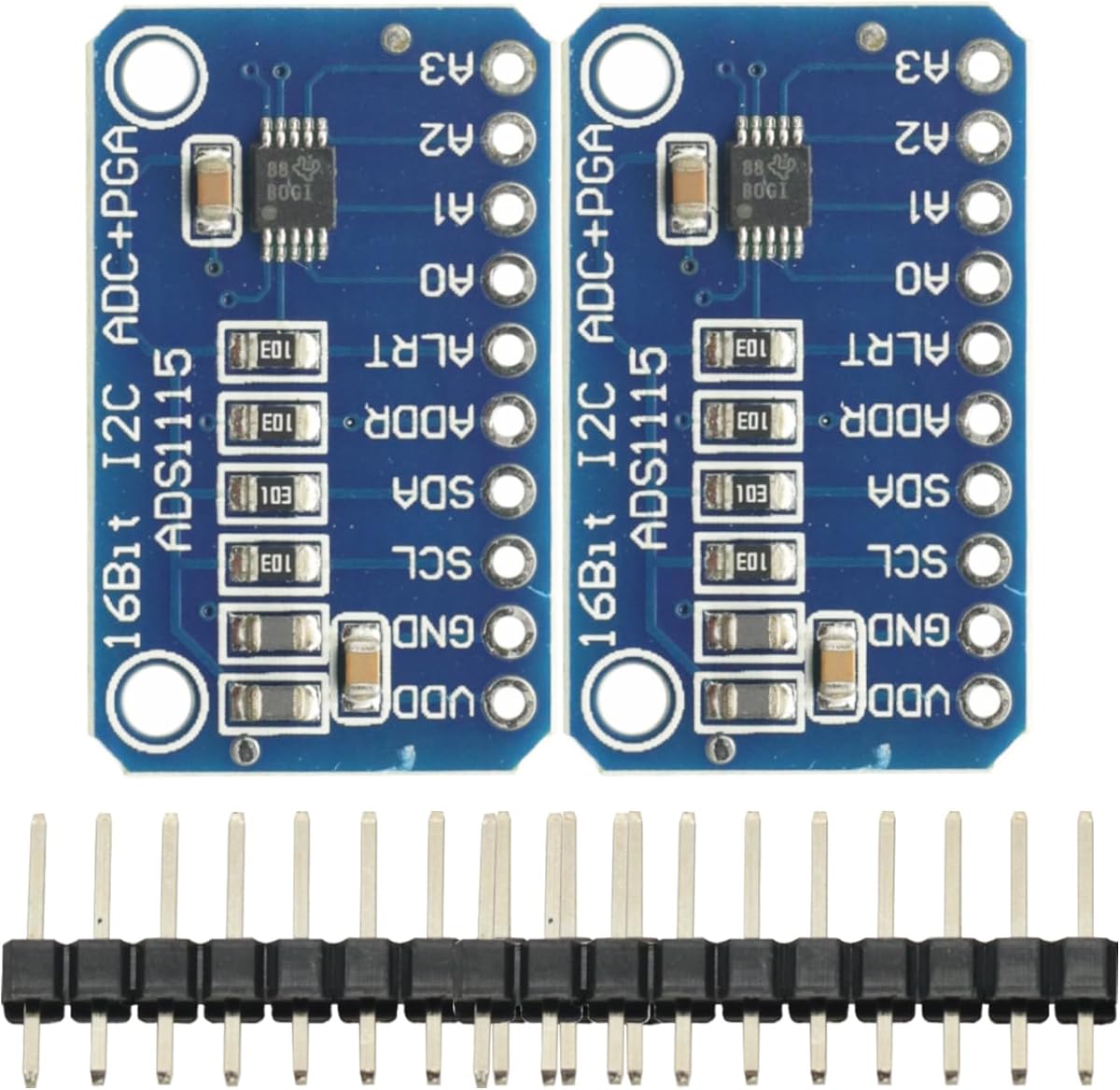


This module delivers high precision at a fraction of the cost of competitors. With a perfect 5.0 rating from verified buyers, it is an obvious choice for budget-conscious makers. The 16-bit resolution ensures you get stable readings for sensors that require more detail than standard Arduino pins provide.
We may earn a commission when you buy through this link, at no additional cost to you.
The key strength lies in its programmable gain amplifier which lets you adjust sensitivity for low-voltage signals. It supports four analog channels or two differential inputs giving flexibility for various sensor configurations. The I2C interface means you only need two data wires keeping your wiring neat and reducing pin usage on your microcontroller.
While the data rate maxes out at 860 samples per second it is more than enough for most environmental monitoring tasks. Some users might prefer faster sampling for vibration analysis but this unit excels in static or slow-changing signal applications. The build quality is solid for the price though it lacks the premium plating found on higher-end modules.
You should buy this if you need reliable analog conversion for multiple projects without breaking the bank. It is ideal for students hobbyists or prototypes where cost efficiency matters most. The pack of two ensures you have a spare ready for future builds or testing multiple sensors simultaneously.
The built-in gain amplifier allows precise measurement of signals as low as 256 millivolts without external amplification circuits.
Supports both single-ended and differential inputs enabling accurate readings even in electrically noisy environments.
We may earn a commission when you buy through this link, at no additional cost to you.
For applications demanding extreme accuracy this 24-bit ADC board stands above the rest. It is designed for professional data acquisition tasks where minute voltage changes matter. The onboard TI ADS1256 chip ensures nonlinearity stays incredibly low making it perfect for strain gauges and precision instrumentation.
We may earn a commission when you buy through this link, at no additional cost to you.
Its eight channels allow you to monitor multiple high-precision sensors simultaneously without multiplexing. The built-in 2.5V reference voltage provides a stable benchmark ensuring consistent readings across varying power conditions. With sample rates up to 30,000 per second it captures rapid changes that standard 16-bit modules might miss.
The main trade-off is the reliance on SPI communication which uses more pins than I2C. It also costs slightly more than basic 16-bit boards but the added precision justifies the expense for critical projects. You will need to ensure your microcontroller has available SPI hardware to interface with this module effectively.
Choose this board if you are building scientific equipment or industrial monitoring systems. It shines in scenarios where resolution and stability are paramount over simplicity. It is a robust solution for engineers who need trustworthy data for calibration or analysis work.
The integrated ADR03 chip provides a precise 2.5V reference reducing drift and improving long-term measurement accuracy.
With rates up to 30ksps you can track dynamic signals effectively without sacrificing precision.
We may earn a commission when you buy through this link, at no additional cost to you.
This package offers three high-quality ADS1115 modules with a focus on durability and compatibility. The gold plating on the contacts prevents oxidation ensuring a solid connection even after repeated use. It is tailored for makers who value long-term reliability and broad ecosystem support for their projects.
We may earn a commission when you buy through this link, at no additional cost to you.
The modules work seamlessly with a wide range of microcontrollers including ESP32 and Raspberry Pi. You get flexible voltage support from 2.0V to 5.5V allowing operation with both 3.3V and 5V logic levels without extra components. This versatility makes it easy to integrate into complex systems with mixed voltage rails.
While the price is higher than generic alternatives the quality control and open-source focus justify the investment. The ENIG finish helps with solderability and reduces the risk of corrosion in humid environments. It is a premium choice for those building devices that need to last or be shipped to clients.
Opt for these if you need dependable modules for production or educational kits. The inclusion of three units means you can distribute them across multiple projects or keep spares handy. It represents a significant step up in build quality compared to standard bare-board options.
ENIG plating ensures corrosion resistance and better solderability for long-lasting connections.
Supported by libraries for C++ MicroPython and CircuitPython across many popular platforms.
We may earn a commission when you buy through this link, at no additional cost to you.
Teyleten Robot offers a solid bulk pack of three ADC modules perfect for group projects or large-scale prototypes. The 4.7 rating indicates consistent performance across units with minimal defects. Each module provides 16-bit precision suitable for a variety of sensor applications from temperature to pressure sensing.
We may earn a commission when you buy through this link, at no additional cost to you.
These boards operate across a wide voltage range ensuring they work with both 3.3V and 5V systems. The internal PGA helps optimize signal strength for better resolution on small voltage changes. With I2C communication you can easily chain multiple units if you need more channels than a single module supports.
The main consideration is that documentation is often minimal requiring you to rely on community libraries. The headers are standard which is fine for prototyping but might need soldering for permanent installs. Still the value of getting three working modules is hard to beat for extensive development needs.
Buy this if you are outfitting a lab or running a maker class. It provides enough units for students to work independently without sharing hardware. The cost savings compared to buying single units make it an efficient choice for bulk procurement.
Three modules allow for multiple simultaneous data logging projects or distributed sensor networks.
Supports supply voltages from 2.0V to 5.5V for broad microcontroller compatibility.
We may earn a commission when you buy through this link, at no additional cost to you.
This three-pack from HiLetgo is a solid option for those needing reliable analog conversion across multiple points. The 4.3 rating reflects consistent quality with most users reporting stable readings. The modules are particularly noted for their utility with Raspberry Pi which lacks built-in analog inputs.
We may earn a commission when you buy through this link, at no additional cost to you.
Key features include a wide voltage supply range and a comparator mode that helps maintain accuracy in varying conditions. You can easily integrate these into existing systems thanks to the standard I2C protocol. The PGA allows you to fine-tune sensitivity for specific sensors without extra circuitry.
While some reviews mention minor variations in header quality the electrical performance remains reliable for most applications. It is a dependable choice for home automation or data logging projects where cost matters but you still want a branded product. The pack of three ensures you have enough for redundancy or expansion.
Select this if you need multiple reliable modules for a distributed monitoring system. It works well for environmental monitoring or industrial control prototyping. The inclusion of three units makes it easier to deploy across different locations or systems simultaneously.
Especially useful for Pi users who need analog inputs without using HATs.
Allows direct threshold detection reducing CPU load during monitoring.
We may earn a commission when you buy through this link, at no additional cost to you.
This listing provides four individual ADS1115 modules which is the highest quantity among standard packs. It is designed for users who need to equip many sensors or have multiple projects running at once. The modules feature an internal oscillator which simplifies the circuit design by removing external crystal requirements.
We may earn a commission when you buy through this link, at no additional cost to you.
You can use these in differential or single-ended mode depending on your sensor type. The internal PGA supports a range of input spans so you can adapt to different signal levels easily. It is a straightforward conversion solution that handles basic data acquisition tasks effectively.
The rating is slightly lower than some competitors which may indicate variations in batch quality. While many users find them functional others report occasional calibration drift. It is best used for non-critical applications where perfect precision is not required but quantity is the priority.
Choose this pack if you need many sensors for a distributed array. It is ideal for smart home setups where you monitor many rooms simultaneously. The value proposition is strong for projects where you need volume over individual unit perfection.
Built-in oscillator simplifies wiring by removing external crystal needs.
Supports differential inputs to reduce noise in long cable runs.
We may earn a commission when you buy through this link, at no additional cost to you.
This two-pack offers a perfect 5.0 rating indicating excellent user satisfaction with quality and functionality. It provides enough units for a main project and a spare or backup. The modules support multiple input ranges allowing you to measure both tiny and larger voltage changes efficiently.
We may earn a commission when you buy through this link, at no additional cost to you.
The interface is standard I2C which reduces the number of pins needed on your microcontroller. With support for both single-ended and differential inputs you can adapt to various sensor configurations easily. The gain amplifier is programmable making it versatile for different signal strengths.
While it only includes two units it ensures high quality based on the rating. The voltage range is broad ensuring compatibility with both 3.3V and 5V boards. It is a reliable choice for projects where you need guaranteed performance without needing a large quantity of units.
Buy this if you need a reliable pair for a primary setup and testing. It fits well for home automation or student projects where quality is key. The high rating suggests consistent manufacturing standards across the batch.
Consistent 5.0 rating suggests reliable manufacturing and user satisfaction.
Seven programmable ranges allow adaptation to different signal levels.
We may earn a commission when you buy through this link, at no additional cost to you.
This module stands out for its high sampling rate of 200KHz which is far faster than standard ADCs. It is designed for applications requiring simultaneous sampling across all eight channels without distortion. The input range is flexible supporting both 5V and 10V options for broader signal types.
We may earn a commission when you buy through this link, at no additional cost to you.
It uses an SPI protocol for high-speed data transfer ensuring you can capture fast signals accurately. The 16-bit resolution provides good detail while the high speed makes it useful for audio or vibration analysis. However the wiring can be complex compared to simpler I2C modules.
The rating is lower suggesting some users find the interface or setup challenging. It might not be suitable for beginners without specific hardware knowledge. Despite this the performance specs are impressive for those who need speed and multi-channel synchronization.
Consider this if you are working on high-frequency signal analysis. It is ideal for audio processing or motor monitoring where timing precision matters. The eight channels allow full system monitoring without multiplexing delays.
Captures all channels simultaneously for accurate time-correlated measurements.
200KHz allows capturing fast-changing signals effectively.
We may earn a commission when you buy through this link, at no additional cost to you.
A strong contender for large projects this pack includes four high-precision modules. The 4.6 rating indicates stable performance across units. It is suitable for IoT applications where you need reliable data from multiple sensors without sacrificing precision. The modules handle a wide range of input signals well.
We may earn a commission when you buy through this link, at no additional cost to you.
Each module features programmable gain and four input channels for flexibility. You can connect them to Arduino Raspberry Pi or ESP32 easily. The I2C interface simplifies the setup reducing wiring complexity significantly. It is a practical choice for multi-point monitoring systems.
While documentation may be sparse the community support for the ADS1115 is extensive. You can find libraries and tutorials easily for most platforms. It is a cost-effective way to scale up a sensor network without buying individual units.
Choose this if you need to monitor many areas simultaneously. It works well for agricultural monitoring or smart building projects. The pack of four gives you enough units for a robust deployment.
Designed for integration with popular IoT development platforms like ESP32.
Users report consistent data quality for temperature and pressure sensors.
We may earn a commission when you buy through this link, at no additional cost to you.
If you only need one ADC for testing a prototype this is an excellent entry point. It offers the same core features as the bulk packs but in a single package. The unit is highly rated for precision and ease of integration with Arduino and Raspberry Pi projects.
We may earn a commission when you buy through this link, at no additional cost to you.
It supports a wide voltage range and includes a programmable gain amplifier for accurate readings. The I2C interface keeps wiring simple and efficient. It is ideal for those who want to validate a sensor design before committing to a bulk purchase.
The main trade-off is that you get only one unit which might not be enough for production. But for initial development it is cost-effective and reliable. The quality is consistent with other HiLetgo modules making it a safe choice for hobbyists.
Buy this if you are testing a new circuit or need a single converter. It works well for standalone sensor nodes or initial prototype validation. It allows you to verify performance before scaling up with larger packs.
Single unit ideal for validating prototypes before bulk purchasing.
Cost effective way to add high-precision analog conversion to a project.
We may earn a commission when you buy through this link, at no additional cost to you.
Selecting the right ADC board depends on your specific needs for precision speed and channel count. This guide breaks down the key factors to consider before making your purchase.
Resolution determines how small a voltage change the ADC can detect. Most Arduino compatible modules offer 16-bit resolution which divides the input range into 65,536 steps. For most hobbyist projects this is sufficient. If you need higher precision consider a 24-bit module.
Higher resolution means better sensitivity for small signals. Look for modules with low noise and stable references for accurate long-term data.
Channels refer to how many independent analog inputs the module supports. Common boards offer four inputs which can be used as single-ended or differential. If you need to monitor more sensors choose an eight-channel option to save time.
Ensure the board supports your required channel count. Some modules support multiplexing but native channels reduce complexity and improve speed.
I2C is the most common interface for these boards using only two data lines. It is simple and allows chaining multiple units on the same bus. SPI is faster but uses more pins which may limit your available pins on the microcontroller.
Choose I2C for simplicity and SPI for high-speed data needs. Consider your microcontroller pin budget before selecting the interface type.
Sampling rate defines how often the module captures a new data point per second. Most 16-bit boards offer around 860 samples per second. If you need to capture fast signals look for modules offering thousands of samples per second.
Faster sampling is crucial for audio or vibration analysis. For temperature or light sensors standard speeds are perfectly adequate.
Arduino and Raspberry Pi operate at different voltage levels. Ensure the ADC module supports your board logic voltage. Most modern boards accept 2.0V to 5.5V making them compatible with both 3.3V and 5V systems.
Check the logic level requirements. Using mismatched voltages can damage components or cause incorrect readings.
Build quality varies between manufacturers. Look for modules with plated contacts like ENIG to prevent oxidation. Reliable headers ensure long-term connectivity especially in environments with vibration or humidity.
Higher quality boards cost more but reduce failure rates. Choose based on how critical your application is.
A programmable gain amplifier lets you adjust the input range. This allows you to measure smaller signals with greater detail. If you use low-voltage sensors like thermocouples this feature is essential.
Check the minimum input range options. Wider ranges offer flexibility but smaller ranges provide higher resolution for small signals.
Well documented boards save time during setup. Look for modules with available libraries for your microcontroller language. Active community support means you can find troubleshooting help easily if issues arise.
Avoid boards with no documentation unless you are comfortable reverse engineering. Good libraries speed up development significantly.
Connect the board to your microcontroller using the correct interface pins. For I2C use SDA and SCL pins. For SPI connect MISO MOSI and SCK pins. Ensure you connect power and ground correctly to prevent damage.
Install the appropriate library for your microcontroller. Most popular libraries are available via the IDE library manager. Write a simple test script to verify the module returns stable readings before starting your main project.
Protect the module from moisture and dust if used outdoors. Use heat shrink or conformal coating on connections to prevent corrosion. Avoid bending the module pins excessively to ensure long-term reliability.
Most boards draw power from the microcontroller via the VCC pin. Ensure your Arduino can supply enough current. For high-power setups use an external power source connected to the module's VCC pin.
Yes most modern ADC boards support 2.0V to 5.5V logic levels. Always check the datasheet to ensure compatibility. Using 5V boards with 3.3V logic without level shifters may cause issues.
I2C uses fewer pins but is slower. SPI uses more pins but allows faster data transfer. Choose based on your pin availability and speed requirements for your project.
Use a known voltage reference to adjust your code. Most libraries include calibration functions. Apply a reference voltage and adjust the offset in your code to match the expected value.
Yes you can connect up to four ADS1115 boards on the same I2C bus. Change the address jumper on each board to avoid conflicts. This allows up to sixteen total channels.
Instability often comes from noise in the power supply or wiring. Use decoupling capacitors and shield cables if possible. Ensure the reference voltage is stable for accurate readings.
We explored ten top-rated ADC boards covering a range of resolutions and configurations. The ADS1115 remains the popular choice for most users due to its simplicity and versatility. For higher precision the ADS1256 offers unmatched performance.
Prioritize resolution and speed based on your specific sensors. Ensure you have the necessary pins and voltage levels for your microcontroller. Quality matters if you plan to deploy these modules in permanent installations.
Always verify current pricing and availability before buying as prices change frequently. Check customer reviews for any recent updates to the product quality. Choose the option that best fits your project scope and budget.