
FLASHFORGE Creator 5 Pro
4.0Editor score
65C heated chamber
Zero waste system
600mm/s CoreXY
This guide compares the best 3D printers for small business needs including speed, material support, and multi-color capabilities to help you choose.
Starting a small business often requires reliable tools that deliver consistent quality without excessive downtime. A 3D Printer for Small Business must balance speed, precision, and material versatility to meet growing customer demands effectively.
We evaluated ten top models based on build volume, printing speed, multi-color capabilities, and ease of use. Each selection offers unique advantages for prototyping, production runs, or custom manufacturing tasks.
Each pick highlights key strengths, ideal use cases, and potential limitations. Prices and availability change frequently, so verify current details before purchasing to ensure the best fit for your workspace.
4.0Editor score

4.5Editor score

4.7Editor score
This comparison table outlines the core specifications of all ten selected 3D printers, helping you quickly identify the model that matches your production requirements.




The Snapmaker U1 stands out as a top contender for small businesses needing multi-material prints. With a 4.5 rating, it delivers precision and versatility without constant manual intervention.
We may earn a commission when you buy through this link, at no additional cost to you.
Its SnapSwap system enables true multi-color printing by switching four independent toolheads in just five seconds. This reduces waste by up to five times compared to traditional purging methods, saving money on filament.
While the price is higher than basic models, the efficiency gains justify the cost for professional prototyping. The learning curve with Orca software is manageable for most users willing to invest time.
Ideal for creators needing functional parts with soluble supports or mixed hardness materials. Choose this if speed and material flexibility are critical to your production workflow.
The automatic tool changer slashes swap time from two minutes to five seconds, dramatically increasing uptime and reducing idle waiting.
Supporting rigid, flexible, and water-soluble materials in one print opens doors for complex parts that were previously impossible to create quickly.
We may earn a commission when you buy through this link, at no additional cost to you.
The FLASHFORGE Creator 5 Pro is engineered for industrial engineering needs. With a 4.0 rating, it offers robust features like a 65°C heated chamber to prevent warping in advanced filaments like ABS and PC.
We may earn a commission when you buy through this link, at no additional cost to you.
Its near-zero waste system completely eliminates massive purge waste by switching nozzles without flushing filament. This drastically slashes operational overhead and material costs while achieving five times faster multi-color printing speeds.
The dual HEPA filtration system traps ultrafine particles, ensuring a safe workspace for extended runs. While expensive, the durability and safety features make it suitable for professional environments.
Best for businesses requiring industrial-grade parts with complex multi-material requirements. Prioritize this if safety and material range are non-negotiable for your operations.
The dual HEPA and activated carbon system maintains a safe, odorless environment, essential for businesses running printers in shared or office spaces.
The active heated chamber prevents warping in advanced filaments, allowing confidence when printing ABS, PC, and PA for robust industrial parts.
We may earn a commission when you buy through this link, at no additional cost to you.
The Bambu Lab A1 offers exceptional speed and precision for beginners or small teams. With a 4.7 rating, it delivers blazing-fast printing while maintaining accuracy thanks to active flow rate compensation.
We may earn a commission when you buy through this link, at no additional cost to you.
Its full-auto calibration ensures every print starts correctly without manual tweaks. The active motor noise canceling keeps the environment peaceful, which is ideal for shared workspaces or home offices.
Although it lacks a heated chamber, it handles common filaments with ease. The only downside is needing to buy the AMS separately for multi-color capabilities, which adds to the total cost.
Perfect for startups needing fast prototyping without technical friction. Choose this if ease of use and low maintenance are your primary concerns.
Active flow rate compensation actively adjusts extrusion based on readings, ensuring consistent layer quality across every print.
Active motor noise canceling technology reduces operational sounds, making it suitable for quiet environments where noise disruption is a concern.
We may earn a commission when you buy through this link, at no additional cost to you.
The Bambu Lab P1S Combo combines an enclosed printer with the AMS for reliable multi-color prints. With a 4.2 rating, it balances speed and reliability for general business applications.
We may earn a commission when you buy through this link, at no additional cost to you.
The fully enclosed body improves performance for advanced filaments, while auto bed leveling ensures high-quality results quickly. You can set up in 15 minutes, spending more time printing.
While it supports up to 16 colors with the AMS, users note that carbon fiber reinforced polymers are not recommended. This limits some specialized engineering applications.
Best for teams needing color variety without complex industrial features. Choose this if you need a fast, reliable machine for general-purpose prototyping.
The fully enclosed body improves print performance for advanced filaments, ensuring consistency across various material types.
With 500mm/s speed and high acceleration, you can produce masterpieces faster, focusing on creation instead of waiting for prints to finish.
We may earn a commission when you buy through this link, at no additional cost to you.
The Creality K2 Plus Combo offers an extraordinary build volume of 350mm per axis, ideal for large batches or big models. With a 4.0 rating, it brings industrial speed to large-format printing.
We may earn a commission when you buy through this link, at no additional cost to you.
It features dual AI cameras for failure detection and flow optimization. The Matrix frame structure ensures rigidity, eliminating resonance during vertical travel for superior precision.
Step-servo motors accelerate at 30,000mm/s², making large prints surprisingly fast. However, the price and complexity might be high for simple tasks.
Best for businesses printing large functional parts or bulk orders. Choose this if size and automation are critical for your specific needs.
Dual AI cameras monitor for spaghetti failures and optimize flow rates automatically, reducing manual intervention during long runs.
Despite the large build volume, it maintains 600mm/s speed with high acceleration, delivering faster production cycles for massive items.
We may earn a commission when you buy through this link, at no additional cost to you.
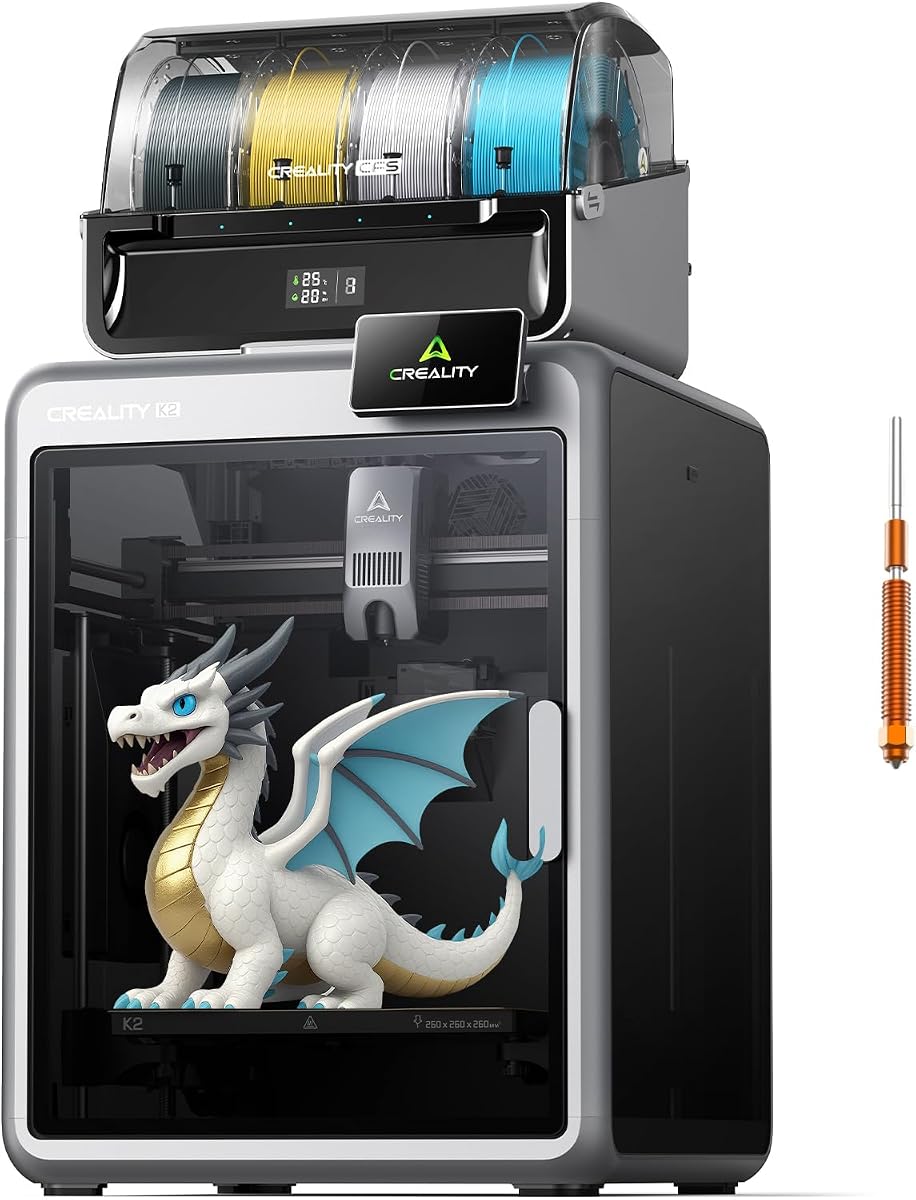
The Creality K2 Combo offers an out-of-the-box experience with 95% pre-assembly. With a 4.0 rating, it simplifies setup while delivering 600mm/s speed and multicolor capability via CFS.
We may earn a commission when you buy through this link, at no additional cost to you.
It uses silent step-servo motors, keeping the workspace quiet. The smart auto leveling focuses only on the print area, saving time on calibration.
While it covers most scenarios well, achieving 16 colors requires hooking up additional CFS units. This adds to the total cost and complexity.
Best for users who want quick setup without sacrificing speed. Choose this if convenience and standard-size production are your priorities.
By adopting step-servo motors and dynamically balanced fans, it remains quieter than a laptop typing, ideal for shared offices.
The leveling sensor probes only the relevant bed area, making leveling faster and more precise than full-bed scans.
We may earn a commission when you buy through this link, at no additional cost to you.
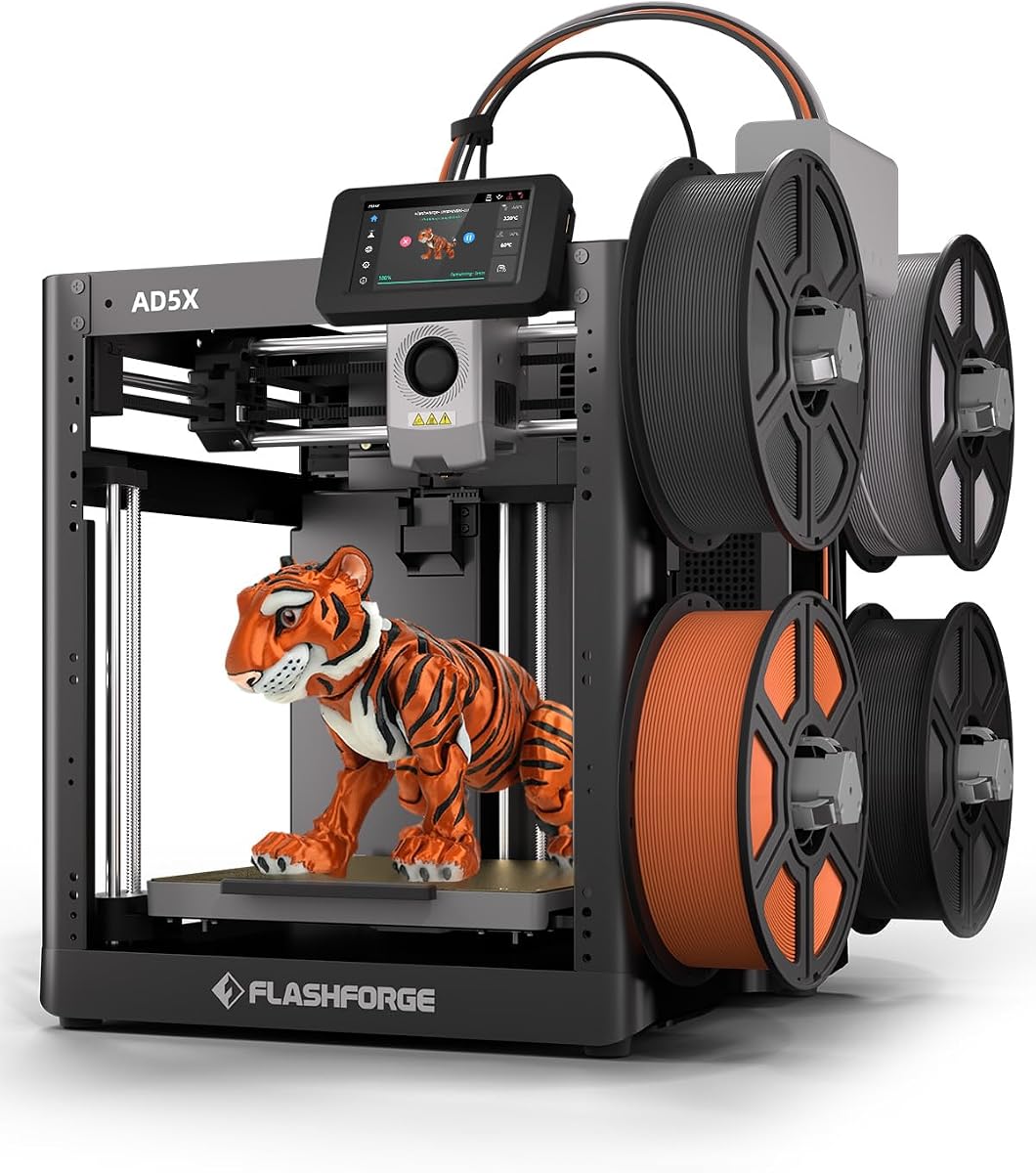
The FLASHFORGE AD5X focuses on speed and efficiency for small batch production. With a 3.9 rating, it offers vivid multi-color prints and 1-click auto leveling for smooth starts.
We may earn a commission when you buy through this link, at no additional cost to you.
Its CoreXY structure delivers 600mm/s speed, reducing production cycles significantly. The built-in resume function handles power loss, ensuring valuable prints are not lost.
You can monitor remotely via the Flash Maker app for added convenience. The build volume is modest, suitable for smaller components or rapid prototypes.
Best for startups needing high-speed turnaround. Choose this if minimizing time-to-market is more important than large build volumes.
The AD5X delivers 12X printing speed, making it ideal for rapid prototyping and batch production without sacrificing quality.
Remote control via the mobile app allows you to monitor progress from anywhere, ensuring you never miss a critical print status.
We may earn a commission when you buy through this link, at no additional cost to you.
The Creality K2 offers a standard version of the flagship model. With a 4.0 rating, it supports up to 16 colors and features a smart filament system with auto identification.
We may earn a commission when you buy through this link, at no additional cost to you.
Its dual-Z-axis and aerospace-grade aluminum frame ensure stability. The built-in air purifier filters VOCs, keeping the workspace safer for daily use.
While it lacks the larger volume of the Plus, it handles engineering-grade filaments well. Setup is easy with guided calibration for beginners.
Best for users needing reliable standard printing with color. Choose this if you want a balanced machine without extra large size costs.
The RFID system reads filament info automatically, while the airtight design with desiccants keeps materials dry and ready for printing.
A built-in air purifier filters VOCs, while the dual-Z-axis delivers ultra-smooth layer consistency and virtually zero wobble.
We may earn a commission when you buy through this link, at no additional cost to you.
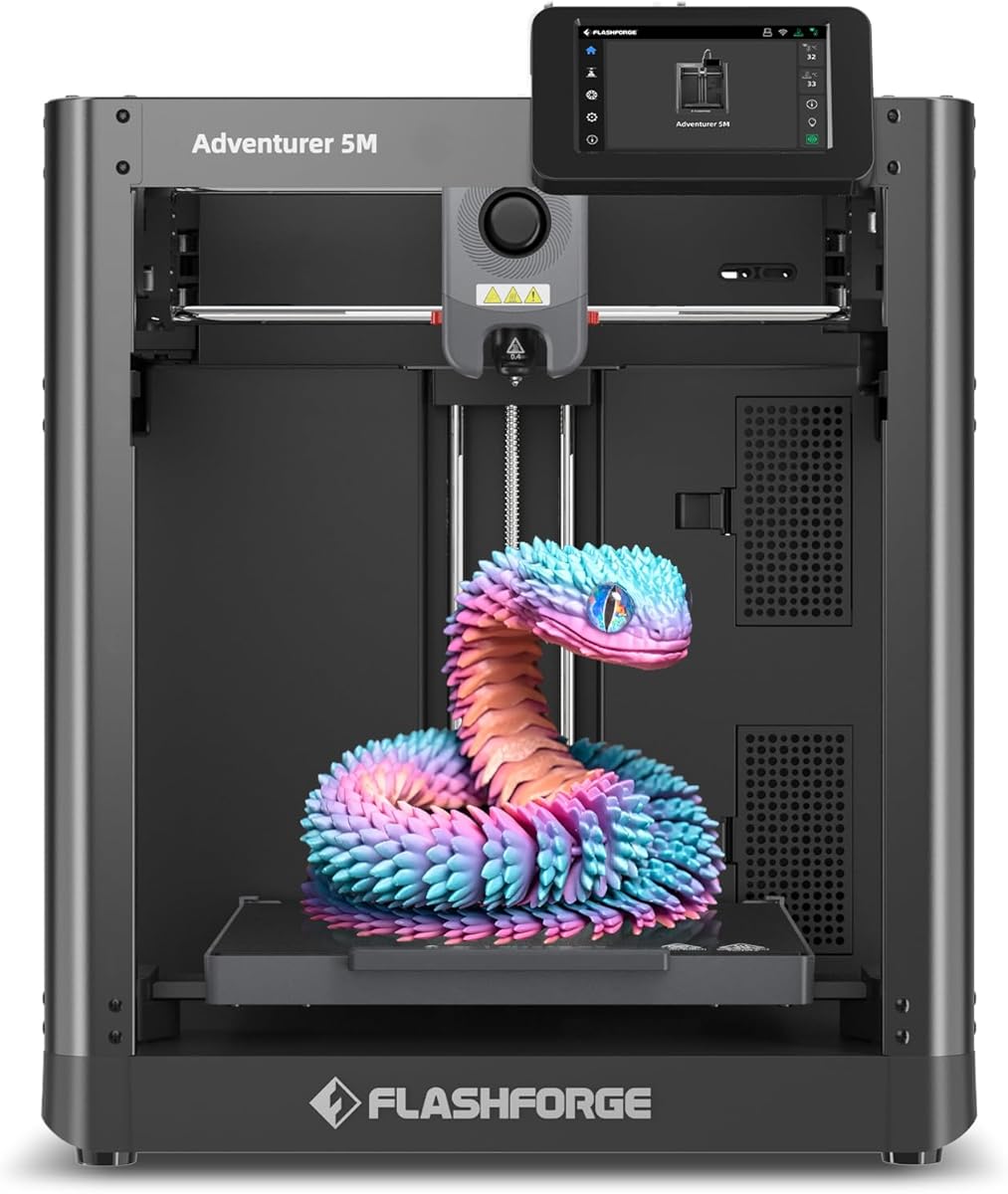
The FLASHFORGE Adventurer 5M is designed for hassle-free operations. With a 3.9 rating, it features fully auto leveling and one-click printing for consistent first layers.
We may earn a commission when you buy through this link, at no additional cost to you.
Its 3-second nozzle changes and high-flow nozzle maximize efficiency. Real-time app monitoring allows instant status alerts, ensuring you stay in control remotely.
The dual-sided PEI platform makes part removal easy. While it lacks advanced features like heated chambers, it delivers solid performance for everyday tasks.
Best for small shops needing reliable, maintenance-friendly machines. Choose this if simplicity and ease of use are top priorities.
Quick 3-second nozzle changes allow you to switch tools rapidly, minimizing downtime and maximizing productivity.
Monitor print progress and receive instant status alerts remotely with the Flash Studio, ensuring seamless control anytime.
We may earn a commission when you buy through this link, at no additional cost to you.
The Bambu Lab P1S offers a reliable enclosed design for various materials. With a 4.5 rating, it delivers fast 500mm/s speed and auto bed leveling for consistent quality.
We may earn a commission when you buy through this link, at no additional cost to you.
It sets up in 15 minutes, making it ready for immediate use. While it supports 16 colors with AMS, it lacks support for carbon fiber reinforced polymers.
The high acceleration ensures quick prints without sacrificing detail. This makes it a versatile choice for general business prototyping.
Best for teams needing an enclosed system without high-end cost. Choose this if you need reliability and speed for everyday projects.
A fully enclosed body improves print performance for advanced filaments, ensuring better results across a wide range of materials.
With 500mm/s speed and high acceleration, it lets you focus on creating masterpieces without waiting around.
We may earn a commission when you buy through this link, at no additional cost to you.
Choosing the right 3D printer requires balancing cost, speed, and material compatibility to meet your specific business goals effectively.
Determine the maximum size of parts you need to print. Larger volumes reduce the need to split models but increase machine cost.
Check the X, Y, and Z dimensions against your largest project needs before purchasing.
High-speed printers reduce time-to-market for prototypes and products. Look for CoreXY structures and acceleration rates over 10,000 mm/s² for better performance.
Prioritize speed if you run high-volume batches.
Consider the range of filaments your business uses, such as PLA, PETG, ABS, or engineering materials like PC and ASA.
Ensure the printer supports the required temperatures and enclosure needs for your chosen materials.
Multi-color printing eliminates the need for post-production painting. Look for systems like AMS or CFS that handle multiple spools automatically.
Check how many colors are supported and if extra units are needed.
Auto leveling and calibration save time and reduce manual errors. Features like AI cameras detect failures early to save wasted material.
Select models with automation to lower operational workload.
Advanced filaments release fumes that may require HEPA filtration. Enclosed designs help contain heat and particulates safely.
Ensure the workspace meets safety standards with proper airflow systems.
User-friendly interfaces and pre-assembled units reduce downtime. Look for intuitive software and responsive community support.
Prioritize machines that match your team's technical skill level.
Consider not just the purchase price but filament efficiency and maintenance costs. Systems with low waste and reliable parts offer better long-term value.
Calculate expected operational expenses over a year.
Begin by calibrating the print bed regularly to ensure first-layer adhesion. Use auto leveling features to maintain consistency across long production runs.
Clean the nozzle and replace it when wear occurs to prevent clogs. Use high-quality filament and store it in dry environments to avoid moisture issues.
Keep firmware updated for performance improvements and bug fixes. Regularly check belts and bearings for tension to maintain print quality and reduce noise.
The best model depends on your needs. The Snapmaker U1 is great for multi-materials, while the FLASHFORGE Creator 5 Pro is ideal for industrial tasks. For budget speed, the Bambu Lab A1 works well.
Enclosed printers are essential if you use ABS, ASA, or PC due to their sensitivity to temperature changes. They prevent warping and improve safety by containing fumes.
Many modern machines reach speeds up to 600mm/s. High acceleration rates further reduce cycle times, allowing faster prototyping and production runs.
Many models feature AI cameras and auto-shutdown to monitor prints safely. Always ensure safety protocols and fire extinguishers are nearby for unattended sessions.
PLA is easy for prototyping, but PETG and ABS offer durability. Engineering filaments like PC are better for functional parts requiring heat resistance.
Regular cleaning of the nozzle, checking belt tension, and lubricating rails keep the machine running smoothly. Replace worn parts promptly to avoid print failures.
Yes, it saves time on painting. However, ensure the system supports your required colors to avoid extra hardware costs.
With proper maintenance, a quality machine can last five to seven years or longer. Regular part replacement extends the useful life significantly.
Selecting the right printer involves balancing speed, volume, and features like multi-color support. Models like the Snapmaker U1 and FLASHFORGE Creator 5 Pro excel in professional settings.
Prioritize automation and safety features to minimize downtime and keep your workspace secure. Match the build volume and material support to your most common business tasks.
Always verify current prices and availability before finalizing your decision. Staying informed ensures you get the best value for your specific production requirements.